
How The Standard Agency Became A Cult-Favorite Matchmaker For The Modern Man
After quietly acquiring two of the industry’s most storied names, the Newport Beach firm is rewriting the playbook on high-end matchmaking.

Matchmaking, for most of its modern history, was sold on pure mystique. Manhattan foyers. Beverly Hills circular staircases. A Birkin strategically placed on the credenza. But a growing class of high-earning men have lost their patience with dating apps, and a different kind of firm has stepped in to redefine the landscape: part boutique consultancy, part executive search—a reimagining of the traditional matchmaking model.
The Standard Agency, operating out of Newport Beach, California, has quietly become the matchmaker of choice for the kind of man who has already optimized and outsourced his calendar, his fitness, and his investments. While long-established competitors like Selective Search and Kelleher International have run six-figure matchmaking practices for decades, The Standard is betting on an entirely different operating model.
That archetype—the man who has streamlined every other system in his life—is the client CEO Jim Justice keeps building for. The calendar, the trainer, the wealth manager, the travel agent: all outsourced. Dating apps were the last place these men were still doing their own intake, and by every metric, it was their worst-performing channel. Twelve conversations a week might yield two dates. Neither woman shows up looking like her photos. One spends an hour lamenting an ex over $24 cocktails. The next morning brings a weightless, polite text: “Had a great time.” Multiply that by a year, and the ROI completely falls apart.
The Standard Agency caught fire when Justice acquired two of the industry’s most storied legacy names—Model Quality Introductions and Professional Matchmaking—and merged them into a single, modernized operation. The pedigree is old, but the methodology is cutting-edge. Justice, who holds an MBA from UNC Chapel Hill, has brought the operational rigor of private equity to a luxury category that had long been content to coast on charm.
Each client gets a dedicated team and a rigorous intake process. A proprietary CRM and data-driven recruiting workflow radically shorten the time between a client’s first conversation and their first introduction.“The industry needed less mystique and more management,” Justice says. “Matchmaking has been sold for 50 years as an art form. It’s primarily a service. We treat it like one.”
“We’re moving to a very high signal-to-noise ratio model. Less foyer, more focus.” — Jim Justice, CEO of The Standard Agency

That corporate rigor extends directly to the recruiting arm—the engine that goes out and finds eligible singles. It operates more like an elite executive search firm than a service trading on serendipity. Every candidate undergoes strict background screens, vetting calls, and in-person interviews. Photos are recent and verified; ages are real.
“Ever tried asking someone’s ‘real age’ on a dating app?” Justice asks. “See how that goes. You can ask our matchmakers, and you’ll get a straight answer.” It’s basic due diligence the apps abandoned years ago, and the lack of it has become one of the loudest complaints among high-value men.
This no-nonsense approach lands exceptionally well with the firm’s mostly male clientele. Matchmaking has been a female-dominated industry for most of its existence, and Justice is one of the very few men running a top-tier firm in the U.S. He notes that this vantage point directly shapes the operation. His male clients want what he wants out of a business: a clear process, defined deliverables, and absolute accountability for the outcome. The Standard Agency was engineered around those exact preferences.
Then there are the aesthetics. The Standard Agency’s predecessor firms, particularly Model Quality Introductions, were famous—and occasionally criticized—for putting physical attractiveness at the top of their selection criteria. “It’s still very much in our DNA,” Justice says bluntly. “We’re here for the male client who has a distinct appreciation for beauty, though we serve a broad array of clients.” It’s the kind of frank statement a previous generation of matchmakers might have softened or apologized for. Justice doesn’t, and his clients appreciate the transparency. The Standard Agency also serves women seeking a highly curated matchmaking experience. “We have many happy female clients looking for their ideal partner,” Justice notes.
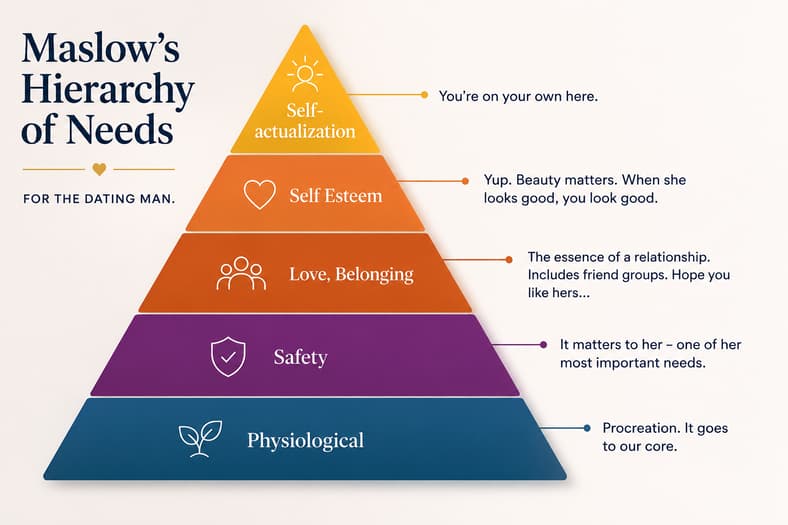
For Justice, the need itself is primal. He points out that, at least for men, finding a partner touches three of the five levels of Maslow’s hierarchy of needs: physiological, belonging, and esteem. For women, it touches a fourth: safety. Few decisions in life pull on that many psychological wires at once, and almost none of them should be outsourced to a corporate algorithm built specifically to maximize screen time.
This service-first ethos also dictates who the firm will—and won’t—work with. The Standard Agency regularly turns away prospective clients if they don’t believe they can deliver results.“If we can’t be successful for you, we don’t sell you a service,” Justice says. The logic compounds: better clients allow the firm to recruit a higher-quality candidate pool, bringing better options to the table.
There is also a critical structural choice most clients never think to ask about. Some legacy firms run a client-to-client model, where both parties are paying members. This often creates conflicts of interest, especially regarding age; wealthier women often want men their own age, while wealthier men tend to prefer younger women. It’s an operational bottleneck.To solve this, The Standard Agency runs almost exclusively on a client-to-candidate model, where only the client pays. “We don’t trick our clients into meeting someone we know they don’t want to meet just to satisfy another paying member’s contract,” Justice notes.

To further modernize, the firm is currently building its own proprietary app. Justice is quick to clarify that it isn’t another mindless swiping interface. Instead, it’s a private dashboard where members review curated introductions, share detailed feedback, and stay in close contact with their matchmaker. “Our app exists to improve our human service, not to replace it,” Justice says. The contrast with Big Tech is deliberate: while dating apps optimize for endless scrolling and user retention, The Standard Agency optimizes for getting its clients off the market for good.
It’s a thesis that is rapidly paying off. The country’s most eligible men are running out of patience with digital dating, prompting a massive macro shift. Match Group, the parent company of Tinder and Hinge, has reported declining subscriber numbers for multiple consecutive years as high-value users opt out.
The media has taken note. Radar Online recently named The Standard Agency one of the five most exclusive matchmaking services in America, scoring the top pick in its “Elite Men” category. Jetset Magazine echoed the sentiment, framing Justice’s approach as the vanguard of a luxury revolution: “Justice’s perspective reflects a broader trend: a shift away from mass-market dating platforms and toward highly curated, discreet introductions.”
For men used to operating in markets where reputation, discretion, and ROI are everything, it’s a language they finally understand. Consider one of the firm’s clients, a 56-year-old commercial developer in Miami who signed on 14 months ago. Like most of the agency’s clientele, he requested anonymity. In that time, he’s been introduced to two long-term partners through the agency. The first relationship ended amicably; the second is currently thriving. “We’ll see where it goes,” he says. “But so far, so good.”
If you purchase an independently reviewed product or service through a link on our website, Maxim may receive an affiliate commission.