
This T-Rex Skeleton Is The Most Expensive Dinosaur Fossil Ever Sold
“Gus” sold for over $50 million, shattering a record set by a stegosaurus in 2024.
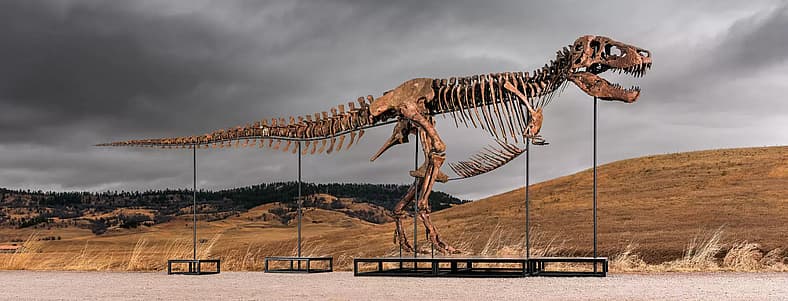
In addition to being ancient Earth’s apex land predator, one tyrannosaurus rex skeleton is now the king of collector dinosaur fossils. A T. rex named “Gus” sold at Sotheby’s for $50.1 million—an astonishing figure made more so by the fact that its pre-auction estimate ranged from $20 to $30 million.
Discovered on a ranch in Harding County, South Dakota by commercial fossil outfit Theropoda Expeditions, the fearsome skeleton is one of the largest and most complete ever excavated, featuring 183 fossil bone elements—including 30 to 32 rare belly ribs—for a 61% completion. As many as 20,000 T. rexes roamed the Earth in the Late Cretaceous period some 66 to 68 million years ago, but only 20 skeletons have been found to date, most of which are incomplete.
Standing some 12.5 feet tall and 38 feet long, Gus would have had an estimated 8,000-pound bite force—twice that of the saltwater crocodile. According to The Guardian, his 67-million-year-old head is actually a replica—the real skull was too large and heavy to be mounted for display.
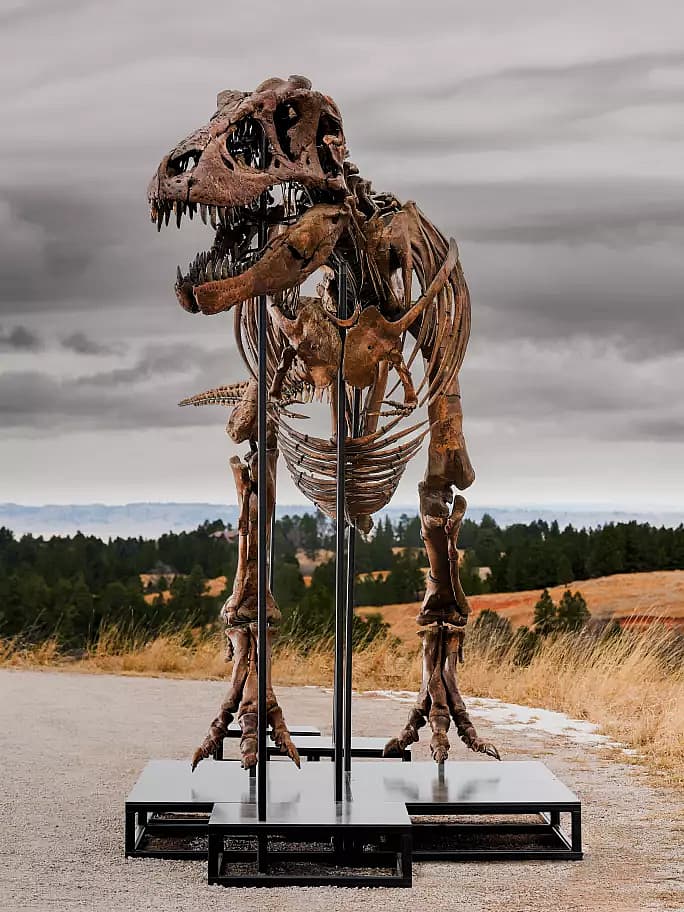
Previously, a stegosaurus had previously set dinosaur fossil sale record at $44.6 million in 2024—the price was justified by “Apex’s” status as “most complete and best-preserved Stegosaurus specimen of its size ever discovered.” As for Gus’s name, Sotheby’s has more:
Gus was discovered by Thomas Heitkamp and his team on land owned by the late Gary “Gus” Licking, a cattle rancher in Harding County, South Dakota. Licking had always had a deep interest and connection to the history of his land, and after years of finding teeth and small bone fragments on the ranch, realized the potential of there being something of true scientific importance just below the surface.
Recognizing the need to bring in professionals, Licking struck up a partnership with Heitkamp and his team who began the arduous work of fossil hunting on the ranch. Intuitively connected to his land, Gary pointed out a suggested area for Thomas and team to search on the 6500-acre parcel and turned out to be spot on; Gus was found right in the area Gary had pointed out. Sadly, Gary passed away only one year into the excavation, never to see this magnificent discovery brought to light. “Gus” has been named in his honor.