
This Supercharged Pre-War Alfa Romeo ‘Torpedo’ Could Sell For Over $5 Million
“The premier prewar Italian sports car” won multiple Le Mans and 1000 Miglia outings.
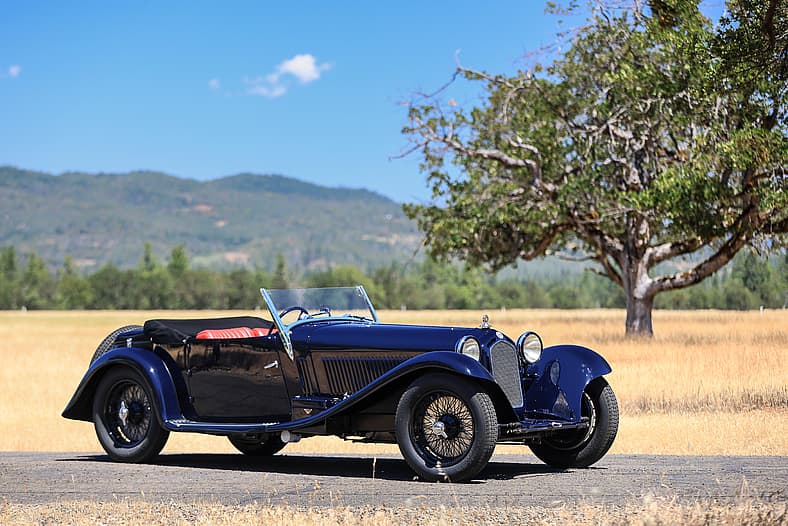
When considering the dollar-per-horsepower metric, this Alfa Romeo 8C 2300 has to be among the world’s most expensive cars… assuming it fetches the top of its pre-auction estimate at Gooding Christie’s Pebble Beach auction.
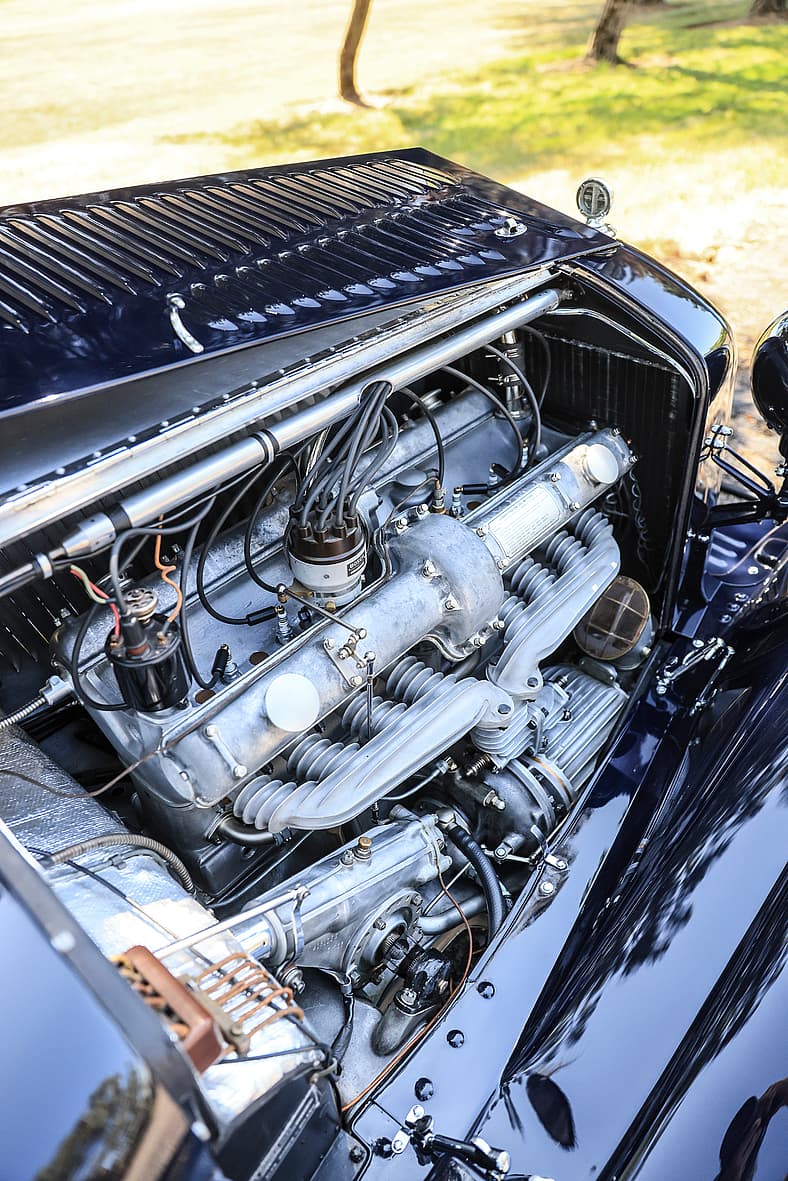
Valued between $4 to $5.5 million, the old-timey performance sports car boasts an all-aluminum, 2.3-liter twin-cam straight eight that’s supercharged to produce 138 horsepower. If it were to hit $5.5 million the buyer would be paying just under $40,000 per hp—for comparison’s sake, Hagerty has calculated that the average automobile’s output costs about $837 per hp.
Of course, that’s hardly the point when considering what the auction house has dubbed “the premier prewar Italian sports car.” The 8C 2300 dominated sports car racing in its day, capturing multiple wins at the 24 Hours of Le Mans and the 1000 Miglia, victories which helped Alfa Romeo sell a road-going version as a bare chassis in short- and long-wheelbase variants. Coachwork would then be commissioned by the customer though firms such as Touring, Zagato and the lesser known Carrosserie Fignoni, which was known for high build quality, fine woodwork, luxurious interiors, and elegant styling.
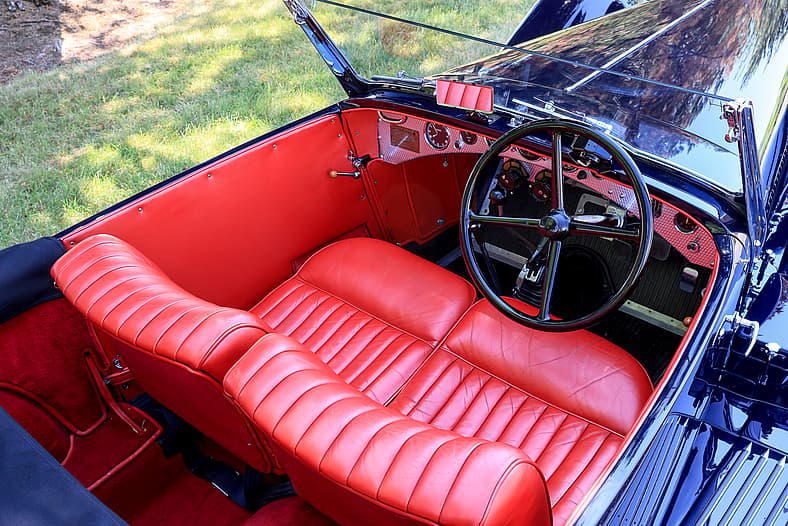
According to Peter M. Larsen and Ben Erickson’s Joseph Figoni: Le Grand Couturier de la Carrosserie Automobile Alfa Romeo, Figoni outfitted seven road-going 8C 2300s between 1932 and 1935 on a built-to-order basis: one Faux Cabriolet and six open-body styles. This striking two-seater, roadster-type Torpedo (i.e. streamlined) body, mounted on chassis 2311207, was ordered to Paris by Alfa Romeo’s first owner, Louis Jeantet, and features distinct elements including a Monza-style cowl with a rare Alfa Romeo Paris badge, a folding soft top with exposed bows, long fenders, a separate trunk, and dual-mounted spares.
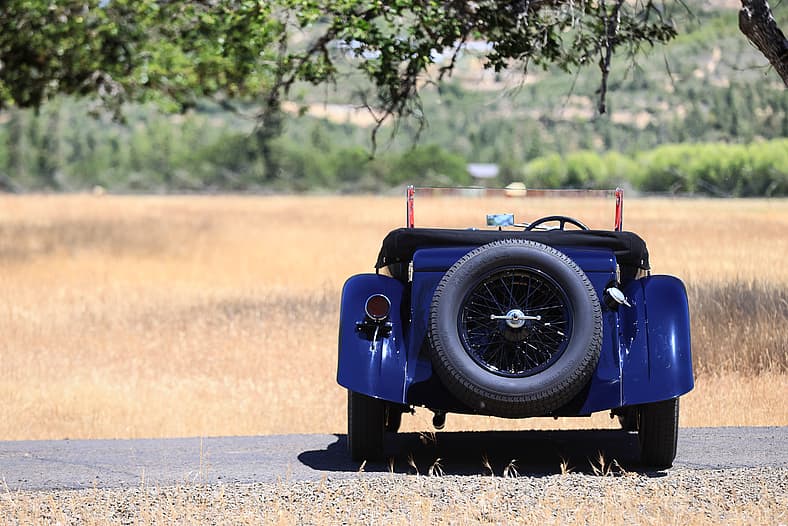
As described by Larsen and Erickson: “The body has no side windows, side curtains, beltline or other ornamentation. It is a body that would be plain from the hand of any other carrossier, but its austerity is alleviated by handsome and perfectly balanced proportions that achieve an understated yet exciting look…It is a classic sportscar style conceived at the cusp in time just before aerodynamic thinking changed car design forever.”
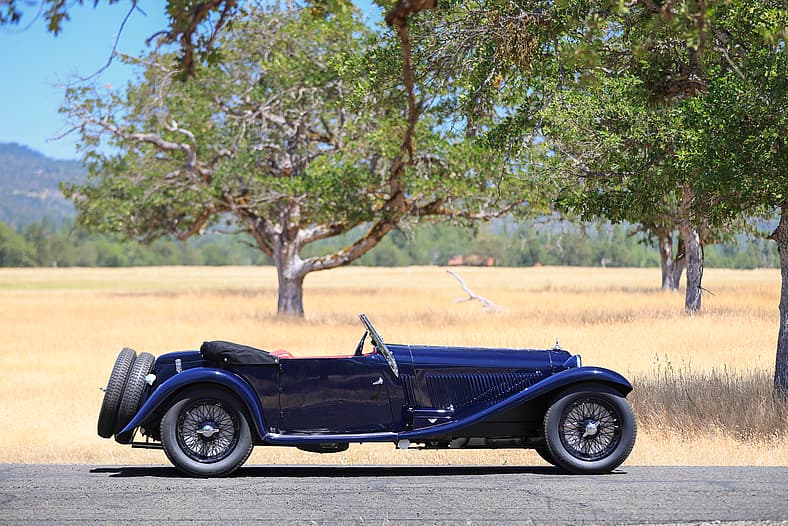
Gooding Christie’s has more on the automobile’s nearly century-old provenance:
It is believed that chassis 2311207 remained in France throughout WWII and was eventually exported to the UK in 1953, where it was first owned by Henry Simms Norman Adams and registered in Norfolk. Around 1961, Adams sold the Alfa Romeo, and it was exported to the US, where it was acquired by noted collector and historian Joel Finn of Syracuse, New York. After a brief period, the car passed into the hands of Stanford Landell, a General Motors executive who purchased the Alfa Romeo on the advice of his colleague, the legendary collector Charles Chayne.
Landell undertook the car’s first restoration, a painstaking multi-year project that was completed in 1965. His work was handsomely rewarded with Best of Show honors at the Carnival of Cars in Detroit and a First Place award at the AACA Fall Meet in Hershey, Pennsylvania. During Landell’s ownership, the Figoni-bodied 2.3 was joined by a Monza and was featured in several notable publications, including The Alfa Romeo Story and Automobile Quarterly.
The car remained with Landell until the early 1980s, after which it passed through a succession of respected Alfisti, including Bill Serri, Peter Agg, and David Cohen. In 1985, it was acquired by Swedish collector Karl Eric Fröjd, who—like Landell—kept the Figoni Torpédo as a stablemate to a Monza.
Since 1988, chassis 2311207 has had just two long-term owners: first, Henry W. Petronis of Maryland, who maintained it for over two decades among his stable of superb prewar classics. The current owner acquired the Alfa in 2010, adding it to a collection of the world’s most celebrated prewar and postwar sports cars. During this stewardship, the 8C 2300 has been exhibited twice at the Pebble Beach Concours d’Elegance, first in 2013 and again in 2022, following a concours-quality repaint by the respected specialists at Dennison International. Today, it presents in a tasteful color scheme of dark blue over red, which perfectly suits its elegant, understated design.
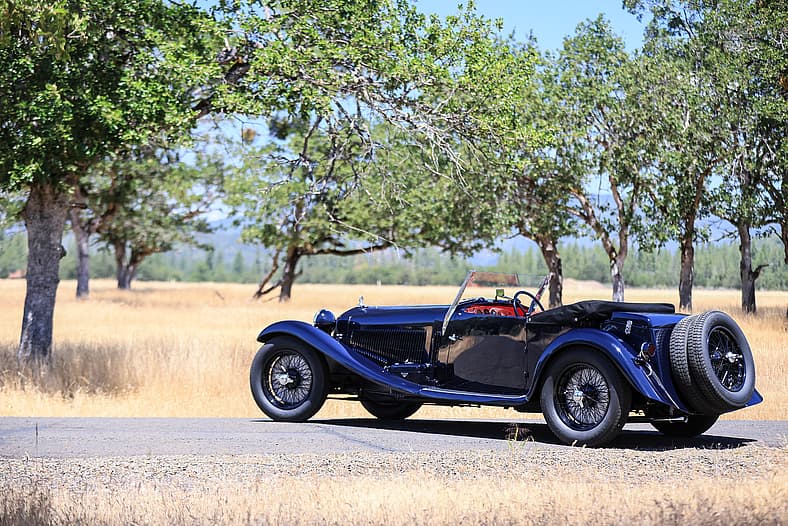
This 1933 Alfa Rmeo 8C 2300 Torpedo hits the block August 15-16 at Gooding Christie’s Pebble Beach Auctions.