
Planes, Trains And Luxury Yachts: Discovering the Secret Wonders Of Vietnam
Over golden sands, remote riverways and in the alleys of Saigon, we uncover the opulence and culinary heights of the Blue Dragon.
The Gold Coast
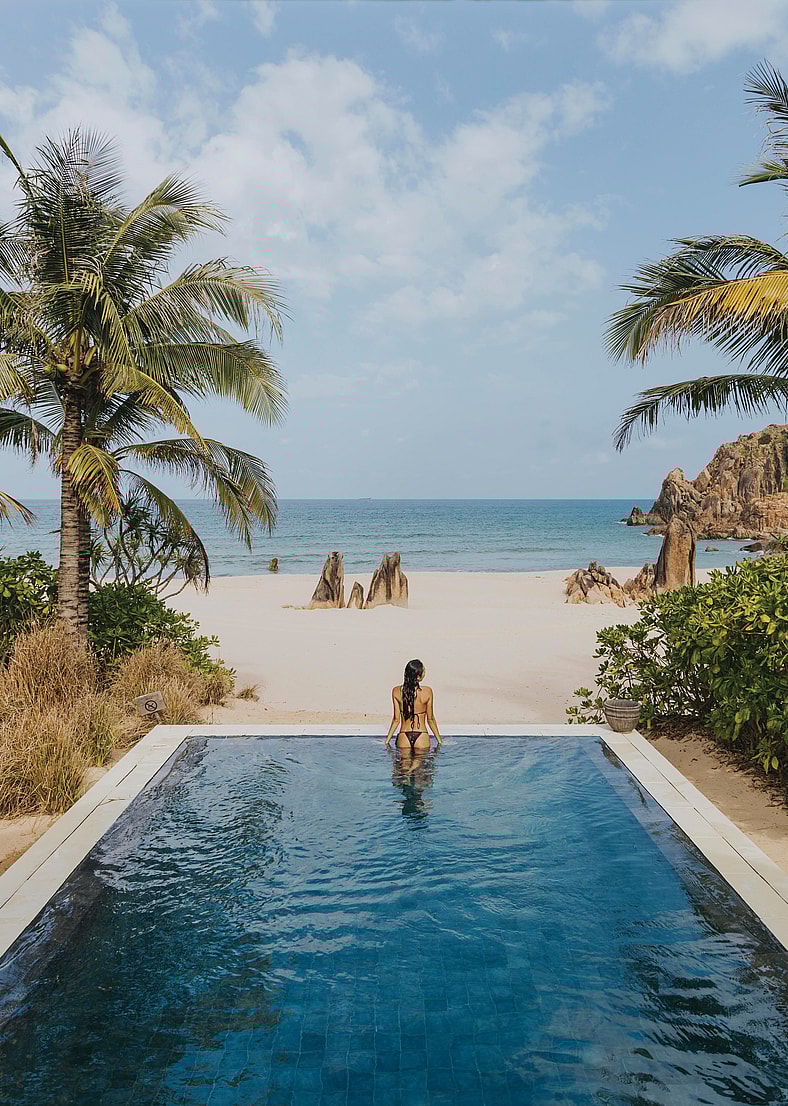
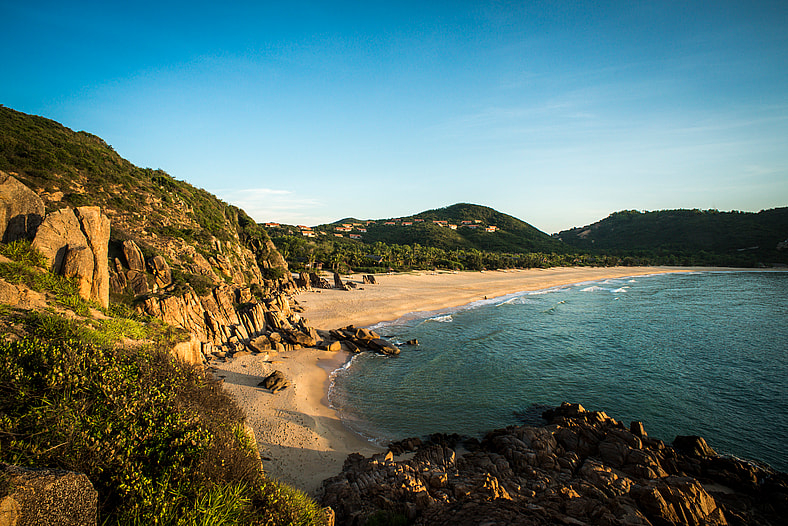
We awake at 6 a.m. sharp on our first morning at the Zannier Hotels Bãi San Hô, with the alert promise of what the day might bring. Leaping from the bed, we peel back the blackout curtains and push open the 10-foot glass door separating our crisp air-conditioned room from the thick Vietnam air outside. The early morning brilliance of it all startles—no less than seven shades of blue wash across our waking eyes, from the infinity pool steps away, to the South China Sea just beyond the beach, and on to the cloudless sky above. Dazzling azures, turquoise, and deep pacific blue light meet our gaze, filling the soul with that elusive euphoria that beckons explorers across the far ends of the Earth.
These moments are what it’s all about. Why we slog through daily chores, file annual taxes and endless online forms, suffer in bureaucratic queues, surviving the stresses and general ennui of modern human existence. Without thinking, we strip off our pajamas and cannonball into the pool, au naturel. As we emerge from the cool water and gulp the air, a single thought enters the brain, which, at the moment, feels like it’s being rocked with fireworks: Welcome to Vietnam.
“Waking up in the morning to a swim in that pool,” a fellow scribe mumbles to me a couple hours later as she chopsticks a dumpling at breakfast, “is like a kiss to my soul.” Couldn’t have said it better myself. As with all mornings at the Zannier Bãi San Hô, we follow our skinny-dip by kicking the day off at the mountaintop Nhà O restaurant with a steaming bowl of pho—the famed bone-broth soup normally reserved for dinner in America. On the terrace overlooking the resort’s vast property, we stir the sliced beef, heaping with fragrant lemongrass and freshly cut green onion, the potent red chilies waking the body for the day’s activities.
Some days that might be an expedition around the Phú Yên province, or enjoying water sports like kayaking, snorkeling, or even electric hydrofoiling across the “Bay of Corals.” Many of our most memorable adventures were curated by luxury travel specialists Black Tomato, who granted us access into secret corners of Vietnam seamlessly. On other days, nothing clogs the personal itinerary other than lost hours sunning on the golden sand, enjoying the gently lapping waves of the Zannier’s kilometer-long protected beach, or soaking in your private infinity pool, reading Kurt Vonnegut with an icy glass of Campari Americano. Deeply inhaling the plumeria and jasmine trees filling the space with the aromatics of royalty, a soft breeze occasionally wafting in from the ocean, carrying some of the heat off your skin.
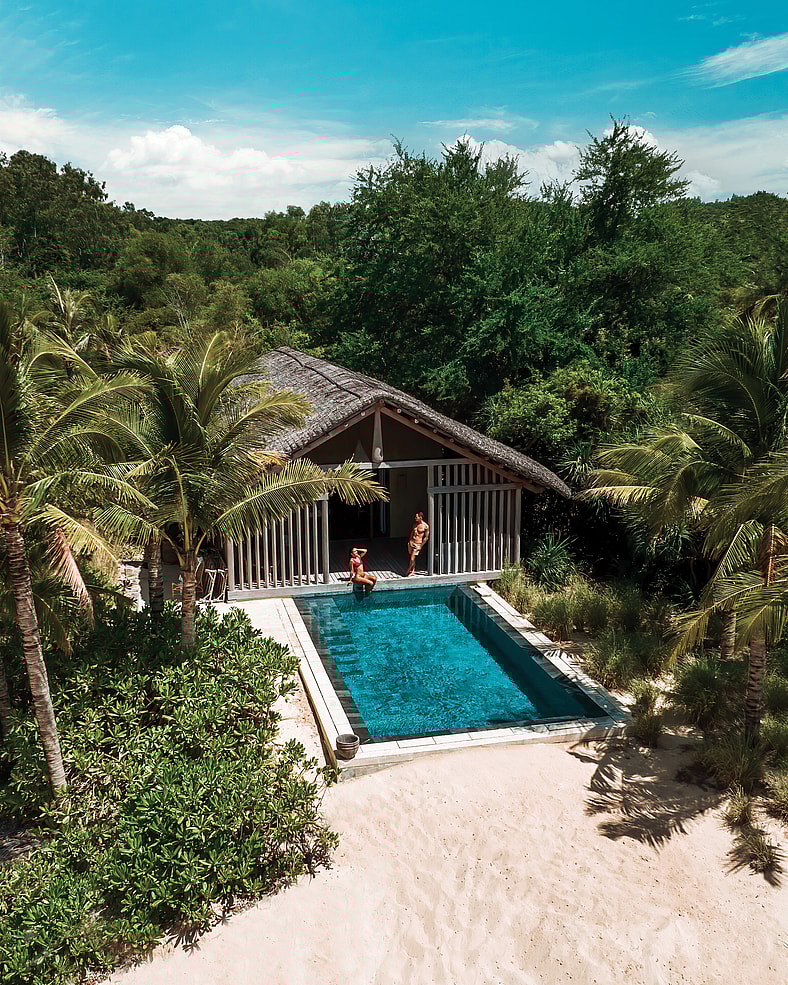
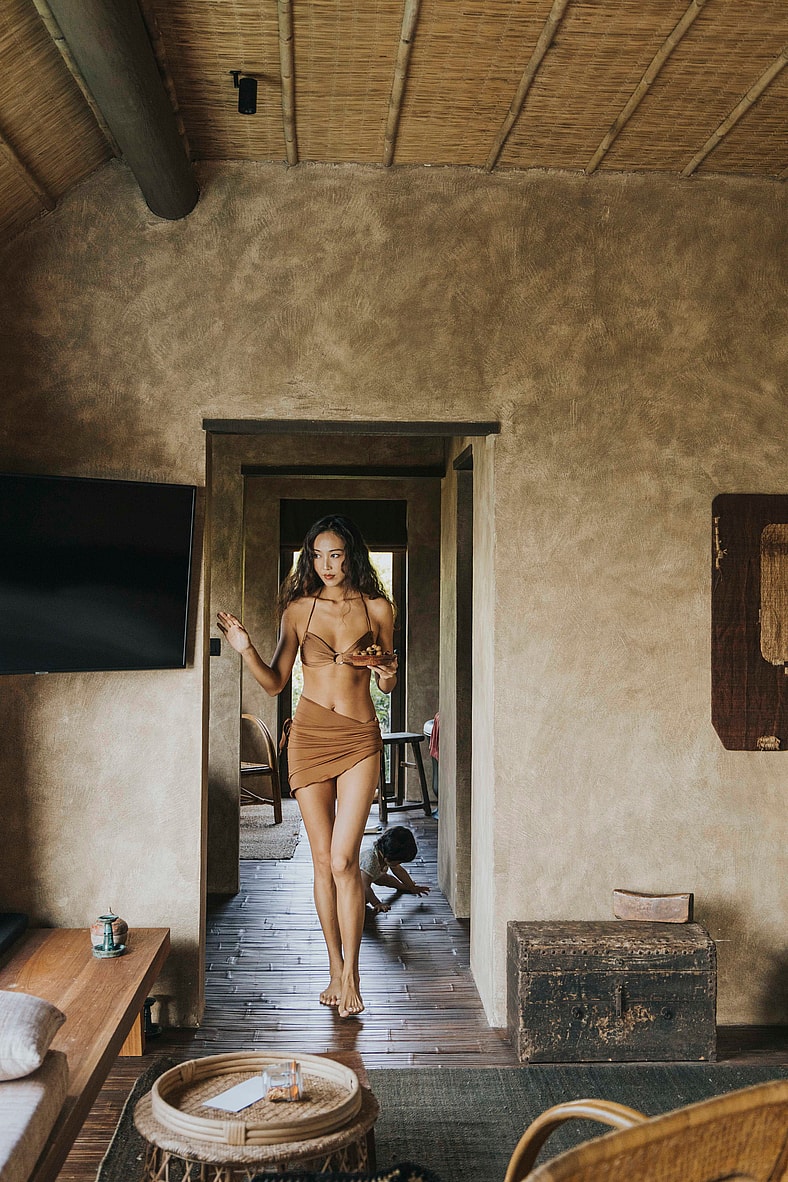
Perched atop a secluded peninsula in the central coast of Phu Yen, the Zannier Bãi San Hô adroitly blends nature, authentic Vietnamese culture and refined Western luxury unlike any other hotel in the region. Every one of the 73 free-standing villas, from one to four bedrooms, boasts its own private pool. Differentiated by three locations spread across the 245-acre sanctuary, each villa also offers its own unique perspective: cresting the hill overlooking the entirety of the resort’s campus and beaches; in the verdant central fields among rice paddies (where Zannier grow much of their herbs and produce); or with private beach access along the sand. Each zone also bears its own architectural style inspired by Vietnamese vernacular, be it fishermen stilt huts, tribal Rade longhouses, or the thatched roof and cob-walled buildings of the Cham people.
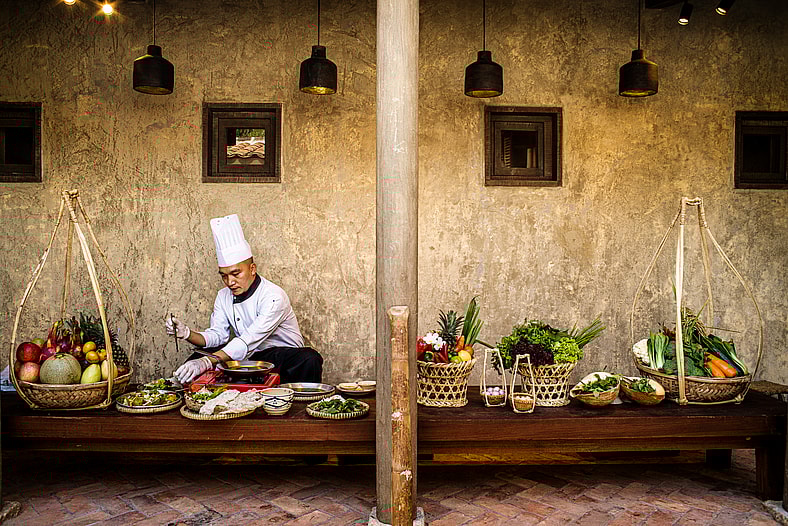
Beyond its spectacular setting, Chef Dung Mai’s respectful culinary direction sets the Bãi San Hô above the pack. Heading up a team of five chefs and two pâtissiers, across the resort’s trio of restaurants one can celebrate every pocket of Vietnam’s world-class cuisine. Signature dishes include fire-roasted langoustine atop a shredded pomelo salad, dry pork belly dripping in caramel, and even a bánh mì bar. Or enjoy superb vegetarian offerings like smoky eggplant with chili soy sauce, and coconut soup with squash and sweet potato.
From your villa hidden in the dense foliage, you will feel alone in the world; you cannot see a single other man-made structure, surrounded by miles of untouched nature, raw and wild and singing with wildlife. Meanwhile, all the fine luxuries usually only available in five-star hotels of the best urban centers can be found just inside your temporary home. Think 65-inch OLED televisions, Yamaha soundbars, fine locally sourced toiletries, and elegantly designed cotton kimonos. There’s a coveted juxtaposition when the fruits of pristine nature counterbalance the pristine fruits of humanity.
It is a view as idyllic as any played anywhere on the planet, in one of the least developed areas of Vietnamese coastline. The only trick of the Zannier Bãi San Hô is getting here; however, in the challenge also lies the reward. For one of the secret blessings of Vietnam is that your method of transportation—when done correctly—is not a chore, but a pleasure unto itself.
One of the secret blessings of Vietnam is that your method of transportation—when done correctly—is not a chore, but a pleasure unto itself.
Trains, Trances & Caviar
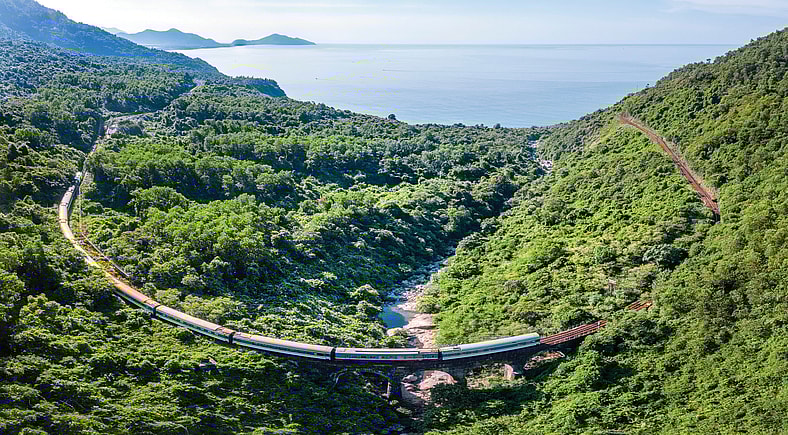
Almost as memorable as being at the Zannier Bãi San Hô is how we arrived: The Vietage, a two-car train entirely curated by the luxury hotel brand Anantara. The first thing that strikes you about the six-hour journey from Da Nang to nearby Quy Nhon is the profound relaxation—not emptiness, mind you, and certainly not silence. For the entirety of the trip, a consistent soundtrack runs gently in the background, a meditative clanking of steel wheels on tracks offset with the happy chatter of fellow passengers (don’t be alarmed, there won’t be many: with only six booths, your car will top out with a dozen riders.)
The peaceful cocoon of your own personal booth will ensure solace, pampering you in Indochine elegance—rattan screens, dark wood paneling, soft lighting, and a steady stream of culinary treats envelope your time onboard. Every passenger even receives a massage in a private room, where the masseur’s gentle hands work out whatever kinks the real world knotted in your muscles. From the moment you settle into your throne, which can fully recline into a bed should you desire a post-lunch/wine-bottle nap, you will sense that time itself has slowed to match the train’s unhurried pace.
The roughly 200-mile journey unfolds through the panoramic windows like a moving watercolor of central Vietnam, lolling one into a deep, sustained trance: past tiny villages, lonely cemeteries filled with soundless bones, and small roads pierced by puttering scooters; water buffalo tilling the fields, tails swatting away flies; fishermen in conical nón lá hats casting nets into sunlit lagoons; flashes of coastline appearing and vanishing between swaying palm trees; and of course countless rice paddies stretching toward distant jungle hills in mesmerizing Mondrian grids.
Make no mistake: The Vietage is not public transport, rather a private salon gliding through the heart of this spectacular country. Riding the historic Trans-Indochinois railway built by the French in the early 1900s, a distinctly Asian version of dolce far niente permeates the entire experience. Spend your time hermited away in your private booth, or belly up to the bar where the Anantara-trained mixologist stirs up a cocktail made with local spirits like Sông Cái, a delicious Floral Gin infused with botanicals culled from the country’s lush deltas, including five fragrant flowers.
The roughly 200-mile journey unfolds through the panoramic windows like a moving watercolor of central Vietnam, lolling one into a deep, sustained trance.
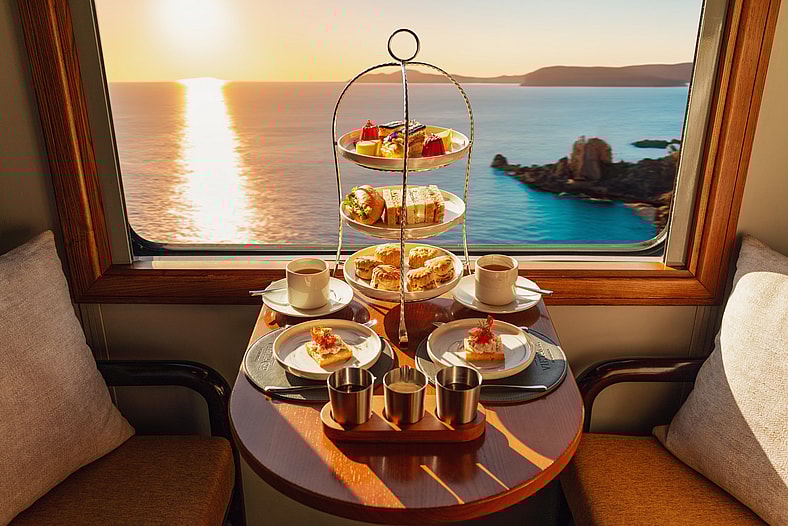
You might start the ride with a La Folliet coconut cream coffee, a potent Vietnamese specialty richer and more complex than most tiramisù. The French-Vietnamese tasting menu feels both refined and rooted—fresh Quy Nhon seafood salad bright with mint, slow-braised wagyu neck in sesame jus, and a Da Lat strawberry and coconut-yogurt dessert that somehow tastes like the color pink. Sparkling wine and bumps of Da Lat caviar follow. Everything from the produce to the plating is locally sourced and seasonally considered. The Vietage’s slow travel philosophy, combined with high-end gastronomy and wellness, turns what should be a simple transfer into a transformative experience. You don’t board the Vietage to get somewhere fast—you board to rediscover how beautiful going slowly can be.
While these rolling landscapes define the Vietage experience, and the sugar-sand beaches of the remote Zannier Hotels Bãi San Hô’s coast dazzle with tropical promise, they do not fully represent the country’s spiritual core. No, you’ll soon find out that in Vietnam everything, in some way, at some point, returns to the river.
Rolling On A River
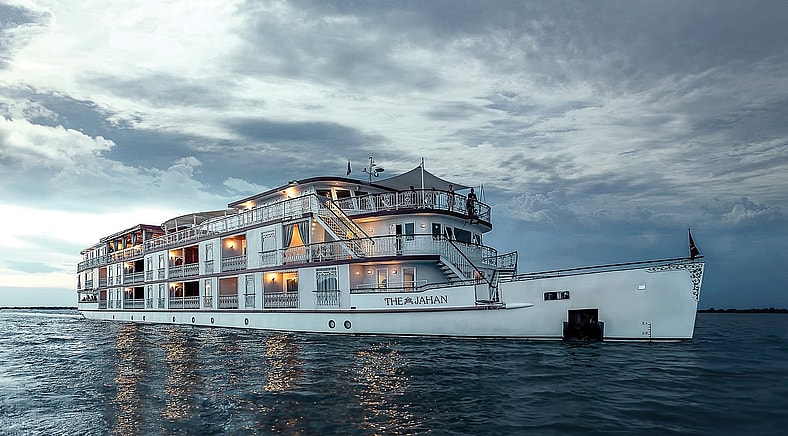
(Heritage Line)
There are some 3,400 rivers in Vietnam, with 16 major basins all spreading like capillaries over 25,000 miles from one end of the country to the other. They are the nation’s lifeblood, arteries flowing trade, culture, livestock, produce, and merriment. None is more important than the Mekong, and no better way exists to experience its awesome reach and import than aboard a ship like Heritage Line’sThe Jahan.
Your weeklong voyage starts near Cambodia’s famed Siem Reap temples, where you’ll board in Tonle Sap. Passing the massive lake’s otherworldly floating villages, the 230-foot flagship yacht will provide supreme pampering as you cruise down the Mekong, discovering both Cambodia and Vietnam in ways simply not possible without you’re own vessel. You’ll jump on bikes and pedal dirt roads, passing stilt homes, locals in conical hats plowing fields with water buffalo, laughing children in moped-powered buses and countless other moments seemingly pulled straight from central casting.
You’ll soon find out that in Vietnam everything, in some way, at some point, returns to the river.
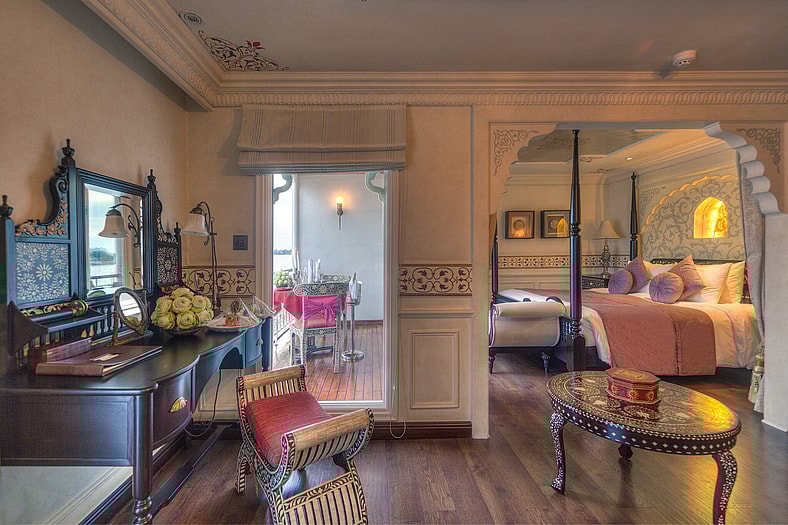
This might be the closest you’ll ever come to cosplaying the old-world elegance of theS.S. Karnak—the luxury steamship Hercule Poirot investigates in Agatha Christie’s famous whodunnit Death on the Nile. Although thoroughly modern under the hood, Heritage Line founder John Tue Nguyen wanted his boats to resonate an old-world charm from a forgotten era, reaching back to a romanticized time of unforced pleasures. So he outfitted his fleet with Raj-style touches like brass hardware, thick Persian rugs, rich mahogany wood, and an overall esoteric nostalgia that feeds the entire Jahan experience.
And because it’s a riverboat that never battles ocean swells, each of the 26 cabins aboard The Jahan features its own secluded balcony—an impossibility on most boats. The phone, lamps, and ashtray—yes, there’s an ashtray on the balcony—are cast in bronze. There’s even a small writing desk in the corner; you can imagine Poirot himself studying notes on his suspects. Each stateroom is simply massive. Some even boast private Jacuzzis. On most ships, the tight confines restrict your room to a mere pit stop—a tight nuisance to suffer in between expeditions and events in common spaces. On The Jahan, your room becomes your own private sanctuary. Stretch away in the queen-size bed, luxuriate in the expansive bathrooms and hot showers; catch your thoughts sitting on the balcony enjoying a glass of Rhône Valley red while puffing a cigar, watching the unfettered life of the Mekong roll along with the wisps of smoke.
On most ships, the tight confines restrict your room to a mere pit stop—a tight nuisance to suffer in between expeditions. On The Jahan, your room becomes your own private sanctuary.
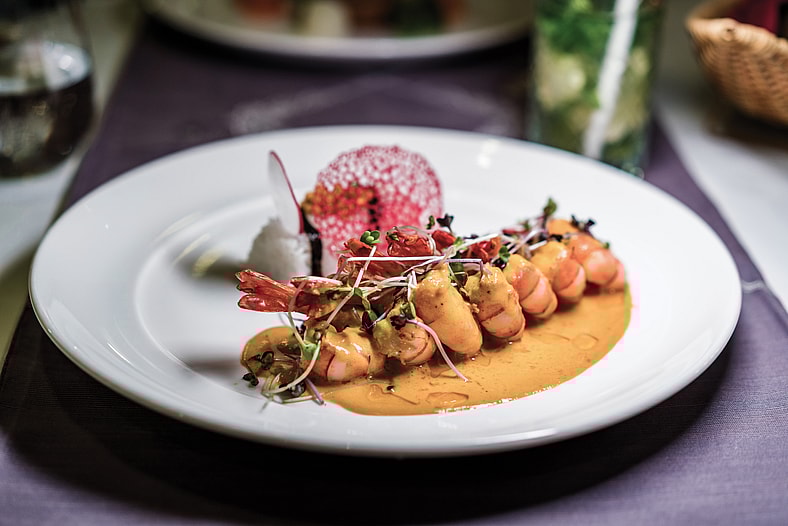
As grand as the cabins are, the common areas impress most. Whether it’s the comfortable lobby with overstuffed couches and a massive central staircase, or upstairs along the marble rooftop bar, or splashing in the Turkish mosaic-tiled pool. Aboard The Jahan, the adventures you’ll experience daily on expeditions will be comfortably balanced by the rejuvenating properties of the boat, including its Apsara Spa. You’ll visit local workshops to witness traditional craftsmanship like bamboo weaving, rice paper making, black clay pottery and distillers turning rice wine into a pungent spirit—often soaking with medicinal cobras and scorpions. You’ll jump aboard “xe loi” rickshaw tours to fish farms and bustling markets overflowing with plums, mangosteen, papaya and bananas.
And every time you’ll return to the Jahan’s opulence, staff waiting diligently with refreshing cold water towels and shoe-cleaning service. That is the wonder of the Jahan: exploring a wild, ancient and yet often primitive world, while offering a floating luxury hotel to return to. One filled with mouthwatering cuisine, cooling swimming pools and life-affirming cocktails.
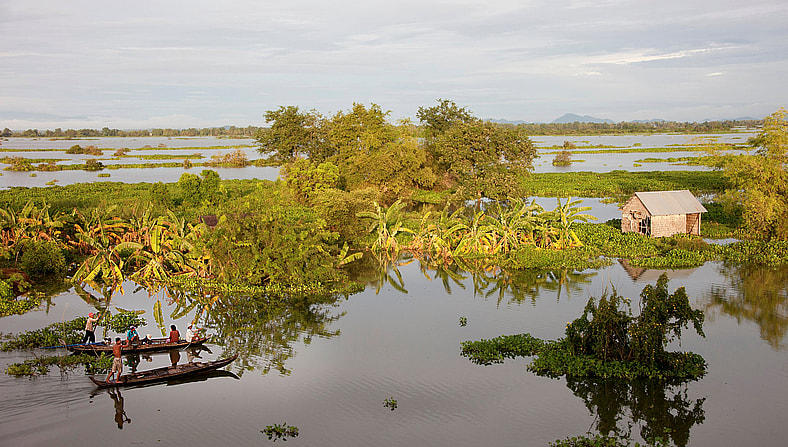
But it is the Mekong itself that plays protagonist during your week-long adventure, continually morphing as you launch from a primitive Cambodian lake into a bustling Vietnamese aquatic highway. To see Vietnam from the river is to see it literally from a different perspective: Countless hours will be lost lounging on the Victorian couches, recounting the day’s adventures. Or doing nothing but watching the distant shore slowly pass by, ecosystems changing with the hours, dramatic sunsets coming and going.
Of course, the Mekong likely won’t be the only river you’ll traverse in your Vietnam journeys. In other cities like the ancient capital of Han life revolves around the Perfume River, with water taxis elevating mundane transfers via Lady Trieu Gin cocktails; expeditions up remote streams to visit small villages are met with sudden downpours, the purple hyacinths swelling with waves in the murky water. In Hoi An, after visiting an eighth-generation dumplingmaker in her 300-year-old house, we boarded small boats lining the Hoai River for one of their famed evening cruises. Here we joined the parade of travelers releasing paper lanterns onto the dark water, wishing for good fortune as the candles drifted away spookily into the night.
The Delicacies of Black Tomato
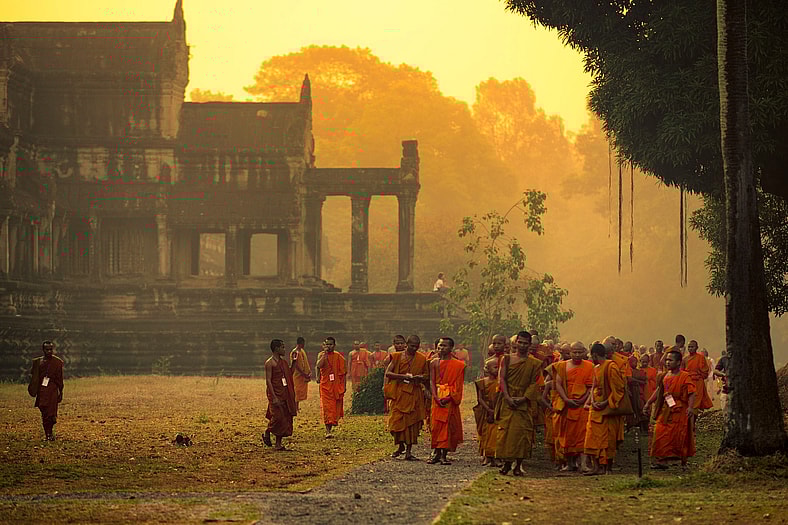
Allow luxury travel specialists Black Tomato to do all the heavy lifting during your Vietnam adventure—both literally and figuratively: carrying bags, planning highly creative itineraries, driving vans, etc.. Black Tomato access their decades of experience to curate only the most discriminating points of interest, taking you into the homes of the most talented dumpling makers, potters and bamboo weavers no matter how remote the village. But they also handle all the annoyances of travel: filing proper visas, scheduling transportation, and securing difficult-to-source reservations.
Black Tomato also offer VIP access no one else can. For instance in the Imperial Palace of Đại Nội, we were allowed to enter the walled city of Huế at dawn, hours before gates opened to the general plebeians. Our small group explored the giant 180-acre Forbidden City avoiding not only teeming crowds but also the suffocating mid-day heat. What Black Tomato excels in is allowing one to focus on the powerful restorative emotions that only travel can evoke, while removing nearly every friction point. And that’s worth every penny.
Saigon Kick
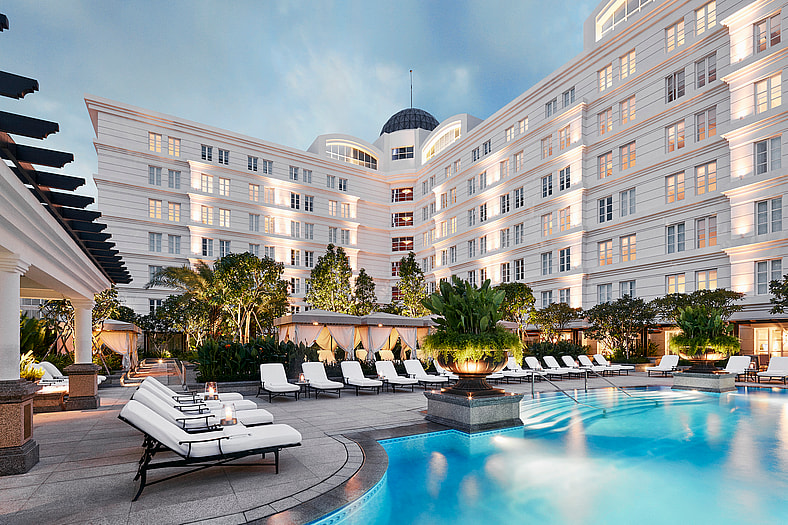
Most likely, your trip will either begin or end in Ho Chi Minh. Leave at least two or three full days to explore not only Vietnam’s most populous city, but also its most advanced. In our short stay, we had two Italian silk suits custom-tailored to perfection; joined a flock of vintage Vespas in an after-dark tour of the city’s labyrinthine alleys; and roamed like pilsner-soaked Anthony Bourdains in search of perfect dumplings, bánh mì, and goi cuon—rice paper rolls filled with shrimp, fresh summer herbs, and vermicelli. While much of Vietnam’s charms rest in remote beaches, traversing tropical escapes and small ancient villages, missing the modern benefits and sophistication of Ho Chi Minh City—including the worldclass colonial refinement of the Michelin-awarded Park Hyatt Saigon—would be a dereliction of duty.
This article originally appeared in Maxim’s Winter 2025 issue. Follow Deputy Editor Nicolas Stecher’s adventures on Instagram at @nickstecher and @boozeoftheday.